

You started intermittent fasting (IF) likely for weight loss. You followed the rules. You skipped breakfast, closed the kitchen at 8pm, waited it out.
And nothing happened.
Or something happened for a few weeks, and then it stopped.
Here’s what nobody tells you when you start IF: intermittent fasting can help manage your weight. But weight loss isn’t a guarantee.
If you’re asking yourself why you’re not losing weight on intermittent fasting, this post is for you. But the answer probably isn’t about the fasting itself.
Because according to this meta analysis comparing IF strategies, IF and a plain-old calorie deficit had essentially the same impact on weight loss.
So IF isn’t magic for weight loss. But it can be a useful metabolic health tool because it works by shifting how your body uses energy. When that shift isn’t happening, that means something else is going on underneath.
Weight loss, energy, blood sugar stability, cholesterol… these are ways to measure your metabolic health and how efficiently things are working in your body. And IF can support these measurements.
Unless you have habits or health factors that work against it.
So instead of telling you to just fast longer or harder, let’s actually look at what might be getting in the way.
What Intermittent Fasting Is (and Isn’t)
Intermittent fasting is a time-restricted eating pattern. It is not a diet plan. So basically you’re changing when you eat, not what you eat.
Which is why people like it.
IF works by triggering a metabolic switch. When you eat, your body breaks down food into glucose and runs on that.
Now in a fasted state (after we’ve used the energy from our meal) our body also uses up our glucose reserves (in our liver and muscles) and eventually switches to burning fat for fuel.
This is why research links IF to improvements in insulin resistance, cholesterol, and other cardiovascular risk markers. Not just body weight.
Which means if IF isn’t working for you, we want to re-evaluate how we’re approaching IF.
12 Reasons Intermittent Fasting Isn’t Working For You
These are the most common reasons — and most of them have a fix.
- Your fasting and eating windows are wrong for you
- Your fasting window is too short
- Too many calories during your eating window
- Not eating enough
- Not enough protein and fiber
- Your food quality needs work
- You need more movement (or different movement)
- You’re not sleeping enough
- You’re not drinking enough water
- You have a health condition that’s working against you
- You have unmanaged insulin resistance or another metabolic issue
- Intermittent fasting just isn’t the right tool for you
1. Your fasting and eating windows are wrong for you
IF is flexible because you’re just changing when you eat. These are the most common patterns:
- 16:8 — fast for 16 hours, eat in an 8-hour window
- 5:2 — eat normally 5 days; restrict to 500–600 calories on 2 non-consecutive days
- Eat-stop-eat — 24-hour fasts, twice a week
- Alternate-day fasting — fast every other day
- Periodic short-term fasting –lasts more than 24 hours and up to 72 hours
According to this meta analysis, alternate day fasting seems to show some additional (but trivial) benefit for weight loss. And while there’s potential for greater impact on metabolic health with longer fasts (like at least 24 hours), that won’t matter if you can’t stick to the fasting period.
And that’s actually a common issue with longer fast times. They’re really hard to keep doing.
The fix: Try a different eating schedule. Don’t start at 16 hours. Start at 12 or 14 hours and work your way up. The goal is consistency. Not intensity.
2. Your fasting window is too short
If your goal is pure weight loss, then you don’t need to worry about your fasting window as long as you’re in calorie deficit.
But to get the metabolic health benefits, your body needs to reach and stay in a fasted state. That switch from using our glucose stores to fat for energy tends to happen around 12 hours post eating.
This figure from Anton et.al does a nice job of showing what your body uses for energy (glucose vs fat) based on when you eat (noted with the red arrows).
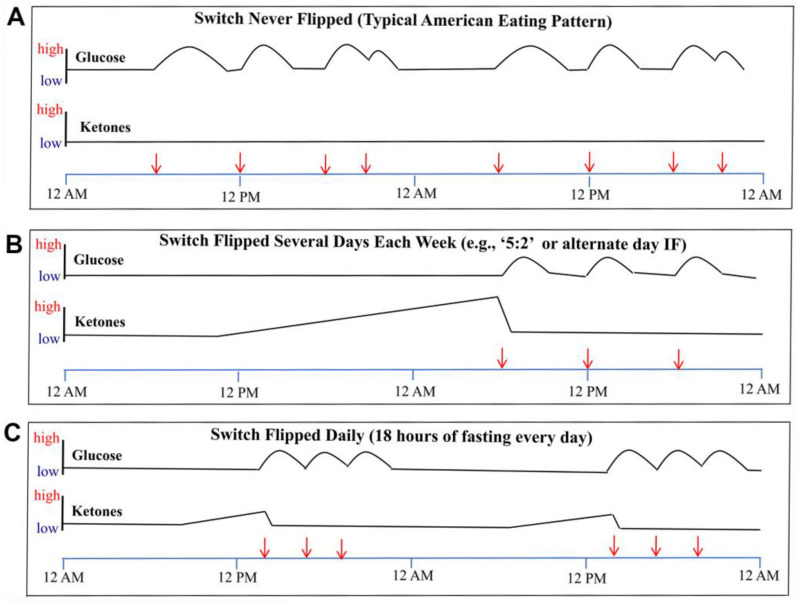
The fix: Adjust your fasting window so you’re fasting for at least 12 hours.
3. Too many calories during your eating window
Most people doing intermittent fasting just skip a meal, like breakfast. This usually puts them into a calorie deficit which is what leads to the weight loss.
But if you’re breaking your fast and eating everything in sight, you might be canceling out that deficit.
And if you drink alcohol, that could also be cancelling out your deficit and keeping your weight where it’s at.
The fix: Track your intake for a week so you have actual data to work with. It’s very common to underestimate how much we eat because we think about the big things. Not so much the sauces, drinks, dressings, or handful snacks we grab. So see if you’re eating at maintenance calories or if you’ve reached a true deficit.
4. Not eating enough
Under-eating is not a shortcut to better health. Sure you might lose weight in the short term. But if you’re really not eating enough, you’ll also lose muscle or bone mass. We don’t want that.
And your body will do everything it can to get your weight back to “normal” if you’re not in a sustainable calorie deficit. Like increase your hunger levels. Or undergo metabolic adaptation (basically using less energy).
The fix: Calculate your maintenance calories using the Mifflin-St. Jeor equation (or an online calculator). Then aim for a 250–500 calorie deficit — not more.
Or work with qualified professional like a Registered Dietitian. Not some rando trainer who wants you to do weird calorie cycles.
5. Not enough protein and fiber
Most people eat enough protein when they aren’t fasting. But once you shorten your eating window, you’re probably also eating less protein. It’s possible to still eat enough protein while fasting. But you might need to add a little extra from a smoothie, broth or even a protein drink to help make up any big differences.
Protein is important because it helps you feel fuller for longer and also makes sure your body doesn’t break down your muscles for energy. Fiber also helps with feeling fuller too.
Most people don’t get enough fiber though even when they don’t fast. The general recommendation is to have about 25g per day for women and 38g per day for men.
So if you already don’t get enough fiber and then you start IF, you might get even less fiber. And that might make you constipated because fiber helps with staying regular.
And if you’re doing IF for the metabolic health benefits but skipping out on fiber, you’re not doing yourself any favors. Fiber helps control your blood sugar and it feeds the “good bacteria” in your gut. Both are important for your metabolic health.
Now, if you’re constantly breaking your fast early or overeating in your eating window (and it’s a reasonable window), it could be because you need more protein and fiber in your meals.
The fix: Have 1/4 to 1/3 plate full of a lean protein like fish, chicken, lean beef, eggs, or even beans. Fill another 1/4 to 1/3 of your plate with a fiber-rich carb. Then fill the rest of your plate with veggies like peppers, onions, broccoli, spinach or mushrooms. And make sure you have some kind of healthy fat. That’s really all it takes to have balanced meals.
6. Your food quality needs work
There’s a myth that you can eat whatever you want during your eating window because IF isn’t a “diet.” Technically it’s true.
You could technically lose weight eating gummy bears as long as you are in a calorie deficit.
But food quality matters for your metabolic health and fasting won’t change that. You don’t have to swear off your favorite foods. Just make sure you’re eating healthy more often than not…
Aka prioritize less processed foods, eat your veggies, and get fiber in.
The fix: Your plate doesn’t need to be perfect. But aim for mostly whole foods during your eating window and make your meals balanced.
7. You need more movement — or different movement
Cardio is great for your heart. But if fat loss and better metabolic health are the goal, you need to strength train too.
Muscle is metabolically active tissue. According to this article ,”Role of Skeletal Muscle in Insulin Resistance and Glucose Uptake“, your muscles take up over 80% of the glucose in your body after a meal. So the more muscle mass you have, the more muscle to take up your glucose. Instead of it staying in your bloodstream.
This article also points out that glucose can get into your muscle in 2 ways: through insulin or through exercise. So even if you’re insulin resistant, your muscles will still take up glucose if you’re exercising.
And on the flip side: if you’re overtraining or doing too much intense exercise without enough recovery, that’s a stressor on your body which is not good for your metabolic health.
The fix: Start with 2 days of strength training per week. Make sure you hit all your muscle groups. You can work up to 3 or 4 days of resistance training if you want to build muscle faster. But give it 2–3 months because muscle building takes time.
8. You’re not sleeping enough
Nothing good comes from sleep deprivation because it wrecks your metabolic health and you can’t fix that with anything other than sleep.
When you’re consistently sleep deprived, your stress hormones go up, you’re hungrier, less satisfied after eating, and you’re likely too tired to move. This all can increase your risk for insulin resistance.
The fix: 7–9 hours is the goal for most adults but ultimately you know when you’re rested or not. If sleep is genuinely a struggle and not just a scheduling issue, talk to your doctor. Sleep disorders can often be underdiagnosed and they have real metabolic consequences.
9. You’re not drinking enough water
There is research looking into the connection between water intake and metabolic health. And while the evidence isn’t set in stone, it seems that drinking less water can increase your risk for metabolic dysfunction.
Plus if you think you’re hungry but you’re actually thirsty, you might be eating more calories than your body needs. Which would explain why you’re not losing weight on IF.
The fix: A rough target: take your weight in kg (pounds divided by 2.2) and multiply by 35ml if you’re under 55. That’s your daily fluid target in milliliters. Divide by 30 to get ounces. And don’t worry about chugging like 10 cups of pure water. You get fluids from coffee, tea, milk, soups, and foods with higher water content like fruit and veggies. It all adds up.
10. You have a medical condition that’s working against you
Your body just might not respond to IF the way you expected. Conditions like PCOS, hypothyroidism, Cushing’s syndrome, and depression all affect your hormones, metabolism, and body composition in ways that fasting can’t really change.
Sometimes your body’s resting metabolic rate is so low because of your medical condition, or your body doesn’t process things they way it’s supposed to. So the medical condition has to be under control before you’ll see sustainable changes from IF.
The fix: Once your medical condition is controlled, work with a professional like a Registered Dietitian to help you figure out what goals are realistic for you.
11. You have unmanaged insulin resistance
This one deserves its own entry because it’s not really caught until you’re approaching pre-diabetes or diabetes.
But being insulin resistance is not the same as having diabetes. Your blood sugar can be normal because your body will just release extra insulin until eventually you become insulin resistant enough to meet criteria for pre-diabetes or diabetes.
And insulin resistance is definitely a sign of metabolic dysfunction. Plus it makes it harder to lose weight.
Now IF can actually help improve insulin sensitivity over time. But fasting alone isn’t going to magically fix your insulin resistance.
The fix: Get your annual labs done–fasting glucose, A1C, lipid panels. You and your doctor can look at how your labs trend. If your fasting glucose and A1C are trending up, you could also ask for a fasting insulin in blood. Now insurance may not cover that without some risk factors like another medical condition or family history. But it doesn’t hurt to check if you’re already exercising, eating a healthy diet and you’re not seeing any changes.
12. Intermittent fasting just isn’t the right tool for you
IF does work for a lot of people. But the research is pretty clear that you can get the same metabolic benefits — weight management, improved blood sugar control, lowering your cardiovascular risk — through other approaches.
Consistent caloric deficits, eating patterns like the Mediterranean diet or New Nordic diet and regular exercise all have evidence behind them.
IFs main advantage is that it’s simple. But if it’s hard to stick to and feels like a daily struggle, it’s not actually that simple.
Instead, focus on he skills that make any eating pattern work: building balanced meals, understanding your hunger cues, knowing how to eat well when life gets chaotic.
Those skills transfer. A fasting window doesn’t.
The fix: Pick an eating pattern you can actually follow consistently. That’s always going to beat the “optimal” approach you hate. Better done than perfect, right?
The Bigger Picture
If intermittent fasting isn’t working for you, that frustration is information.
It’s telling you that something else needs attention first — your fasting window, your food quality, your sleep, your hormones, or your overall metabolic health. Weight loss doesn’t happen in a vacuum. If you’re not seeing changes, the answer is almost never to fast harder.
So work through this list one variable at a time. If you’ve addressed the basics (diet and lifestyle) and you’re still not seeing changes in your weight, energy, or labs, that’s when it’s worth bringing in someone who can actually look at the full picture with you.
Choose a professional though. Not Tik Tok.
Want to actually understand how your metabolism works?
Most nutrition advice tells you what to eat. Nobody teaches you how.
My free email course walks you through the skills behind metabolic health — not rules to follow, but frameworks that hold up on busy weeks, at restaurants, and with food you actually enjoy.
No meal plans you’ll abandon by Thursday. No supplement stacks. Just the skills to eat well on any week, not just the good ones.

 Dietitian vs. Nutritionist: What’s the Difference and Why It Matters for Your Health
