

If you’re like most people, you’ve probably tried cutting carbs, fasting for 16 hours, counting every single calorie, or following strict plans that promised big results — only to end up feeling frustrated and stuck at square one.
You’re not alone, and you’re not the problem. The truth is, sustainable weight loss doesn’t come from rigid diets. They’re too strict. Weight loss comes from building a healthy, balanced eating pattern so you have flexibility.
By the time you finish reading this post, you will learn:
But before we get into why you lose weight with healthy eating — not dieting…let me answer your burning question (the TLDR version)
How to Lose Weight with Healthy Eating (in a Nutshell)
Add more protein and fiber (like veggies) to your plate. This helps with portion control because you feel fuller for longer.
Increase resistance training to ~3-4x/week (aim for 30-45mins) and do moderate cardio (aim for 60-90 mins)
Eat enough! The only thing you’ll probably lose on that 1200 calorie diet is your peace of mind
Let’s break it down a little more:
Now, let’s walk through a deeper breakdown of exactly why these weight loss tips work, practical ways to get started, and how to build healthy eating into your everyday life.
| Priority | What to Focus On | Why it Helps |
| Add nutrient dense foods | Create balanced meals with veggies, lean proteins, fiber foods and healthy fats | They help you feel fuller for longer and get the most nutrition out of your bite. |
| Eat enough | Being hungry (not hangry) before a meal and being comfortably (not painfully) full | It gives you the energy you need |
| Increase resistance training | Progressive resistance training 3-4x/week | Changes your body composition from fat > muscle |
| Enjoy your food | Eating foods you like…and trying out foods you think you don’t like (in new ways) | Plan all the kale smoothies you want. They’re not nutritious if you don’t drink them. |
| Create routines | Finding things you’ll actually do | Sustainability comes from your habits |
Section 1: Why Diets Fail (and What Healthy Eating Does Differently)
A diet seem like the perfect solution. It offers fast promises and the hope that “this time is finally it” .
A diet lays out “exactly” what to eat to get the results you want.
A diet also sets you up to fail.
But it’s not you (really). It failed you because a diet is a temporary system that’s too strict to fit into your lifestyle. And it doesn’t teach you how to be flexible (and still meet your needs).
Strict diets often trigger an exhausting cycle: restriction → uncontrolled craving → binge → guilt.
And they do more than make you spiral and want to give up. According to Jen Carter, PhD at Ohio State University, strict diets cause changes to your metabolism and hormones that regulate hunger.
This does not help you lose weight sustainably.
So what does healthy eating do differently?
Instead of handing you a list of foods to avoid or a meal template, healthy eating focuses on building patterns.
And healthy balanced eating patterns tend to naturally reduce overeating, give you energy, and help make it easier to make consistently healthy choices overall.
The core of healthy eating patterns comes down to flexibility and how well you can adapt everything you know about healthy eating to your actual choices. Which is very different from strict fad diets that you follow for a few weeks before you get fed up.
Fad Diets Vs Healthy Eating
| Fad Diets | Healthy Eating |
| Strict rules | Flexible structure and patterns |
| Short-term focus | Long-term focus |
| “All-or-Nothing” mindset | Consistency is better than perfection |
| Restriction | Creating more balance on your plate |
| Quick but unsustainable weight loss (which could be from your muscle and fat) | Gradual change in body composition with more muscle than fat |
Where diets teach restriction, healthy eating teaches balance.
Where diets expect perfection, healthy eating makes room for real life.
So if you’ve struggled to stick with strict diets, or you gained the weight back…know this is a common struggle.
Because fun fact–according to Stanford Medicine, around 80-85% of people who lose weight with restrictive dieting gain the weight back (and then some) within a few years.
But first let’s talk about why it’s normal to gain weight.
It’s Normal to Gain Weight
There are times where we must gain weight. The two best examples I can think of:
1). Puberty-children need to gain body fat to go through puberty. Especially female bodies.
2) Pregnancy-women need to gain weight for a healthy pregnancy.
But, gaining weight is normal for anyone.
The average adult actually gains around 1-2 pounds every year until they’re around 65 years old. A study from 2013 published in the research journal Obesity looked at how much weight young people were expected to gain by the time they were middle aged. And this found that over 90% of males and females did gain weight. And this weight gain put them in a higher BMI category.
So if you’re gaining weight as you get older…it’s normal.
The Truth About The Body’s Relationship with Weight
It’s not natural for the body to lose weight “without trying”.
And when I say trying, I mean you’re physically active, building or maintaining muscle, and eating balanced meals.
Because think about it. The only times people truly lose weight without trying is when something is wrong. Like they’re sick or have cancer.
So if we want to lose weight, it has to be intentional action. We need to make changes to how we eat, move and care for ourselves.
There is a set point theory with weight that suggests our body tries to maintain weight around a set point (aka our current weight).
And our body has systems to adapt to changes in our diet and lifestyle–like increasing our hunger levels or using less energy to help it maintain it’s current weight.
But other research suggests weight is more of an upward trajectory over the lifespan. And we’re gaining that as fat, especially once we hit 30.
And this happens for several reasons. We use less energy at rest (aka our metabolism slows down). We lose muscle mass and gain fat (which contributes to our metabolism slowing down). And we’re not changing our eating habits to match.
We’re also less active, especially with activity that preserves or builds muscle.
But we still want to maintain a healthy body weight we’re comfortable with.
So, what is the best way to actually lose weight then? Change your body composition (aka build more muscle).
Section 2: Why Building Muscle Supports Healthy Weight Loss
When you think about losing weight, we’ve all heard we need to just burn more calories than we eat.
But we can only cut so many calories. The real key to long term weight maintenance is building muscle through resistance training.
Cardio is still important because we want healthy hearts. But muscle tissue is metabolically active. Which means you burns more calories even when you’re doing nothing. So the more lean muscle mass you have, the more energy your body is using. And that helps with long term weight loss because you can only cut so many calories before you’re hangry. Or worse. Undernourished.
And is the goal really to cut a ton of calories and eat almost nothing in a day? Or is it to reduce body fat and live your best life?
I really hope it’s the second option. Which means we want to incorporate resistance training.
So we can keep the foods we enjoy and know they fit into our balanced meals.
Resistance training doesn’t have to be complicated or time-consuming.
You don’t need to spend hours at the gym. 30-45 minutes is fine. And depending on how many exercises you’re doing, even 20 minutes might cut it. But don’t forget to warm up and cool down. We don’t have time for pulled muscles around here.
Lift weights, use resistance bands, or do bodyweight exercises like squats, lunges, and push-ups a few times a week. And you’ll start to feel a difference as you go heavier.
Now, remember. Weight loss is an active process. And it takes times to do it in a way that will last. So we won’t see immediate weight loss results. But try looking at other signs of progress. Like maybe you’ll have more energy.
Or make it through an entire workout without feeling like you need to flop in the floor afterwards.
Reasons to prioritize muscle-building to lose weight without a diet
- Increase your metabolism: More muscle means a higher resting calorie burn.
- The body composition you want: You’ll look stronger, more toned, and feel more energized.
- Improve your confidence: Go get that strength! But really. You’ll see yourself get progressively better at something and if that doesn’t make you confident…I don’t know what will.
And as we get older, we want our bones and muscle to stay as strong as possible to reduce the risk of injury or frailty. Do you have time for osteoporosis? I don’t think so! Resistance training helps prevent that.
And as you’re strengthening your body, you need to support it with healthy eating.
The Core Principles of Losing Weight with Healthy Eating
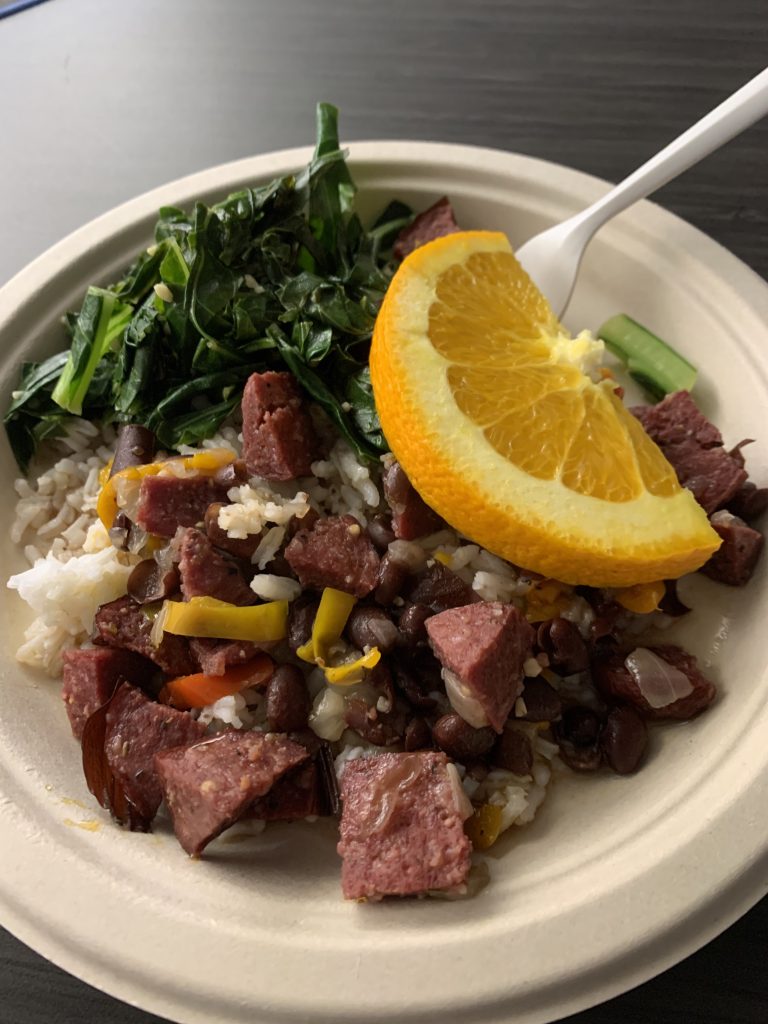
Now, healthy eating. It works because it works with your body. Healthy eating really is just getting enough of some things (like veggies, fiber, protein, calcium) and limiting others (like added sugar, saturated fats and sodium).
No food it “bad” or “good”. So, there’s room for all foods (yes that includes your cookies and ice cream). Which gives you a lot more flexibility. With way less guilt
When you stop chasing diets and start focusing on healthy eating patterns, a few key principles make all the difference:
1. Focus on nutrient-dense food you like.
Healthy eating isn’t sad salads 7 days a week I promise. Even though we can eat anything in our healthy eating pattern, we want to prioritize nutrient dense foods to create balanced meals. Nutrient dense means we get a lot of good nutrition for the bites we’re taking. Food labels will help you decide if something is nutrient dense or energy dense (learn how to read a food label)
Foods like vegetables, fruits, whole grains, lean proteins, and healthy fats are all nutrient dense foods. If you’re saying “oooh I’m picky, I don’t like a lot of vegetables”, then check out how to make vegetables taste good here.
2. Understand true hunger versus emotional eating.
Listen to your body. Are you reaching for that candy bar because you’re actually emotional…or because you’ve only had 300 calories so far today and it’s 4pm?
We tell ourselves we just “need discipline” or the internet convinces us we’re “emotional eating”. Then we spiral into the “I should eat this, I shouldn’t be eating this because it’s not healthy” and we double our stress (also not good for weight loss).
When really our body really just needs more energy to thrive.
3. Balance portions naturally without strict measuring.
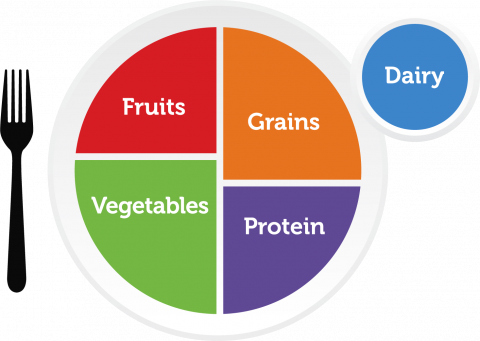
Instead of obsessing over serving sizes, aim to fill your plate with a healthy balance: half vegetables, a quarter protein, and a quarter whole grains or starches. Over time, your body learns to trust normal, satisfying amounts of food without overthinking every bite.
Grab your free one-page checklist for healthy eating
Download the Healthy Eating Starter Checklist — a simple, no-rules guide to help you build balanced meals and consistency without starting over every Monday.
Section 3: Simple Shifts You Can Make Today
You don’t need a massive overhaul to start eating healthier — just small, doable changes that fit into your real life:
1. Add before you subtract.
One of my favorite dietitians–Kylie Sakaida (@nutritionbykylie)– always says “always remember what can you add to, not what you can subtract from your meals”.
That stuck with me and it’s what I teach my own clients. Because we’ve been taught that healthy eating means eating less and cutting out foods. But when that leaves us eating sad salads 7 days a week…it’s no mystery why it’s hard to sustain.
Also, food is so much more than just nutrition. It’s how we bond with others. Share culture. Express feelings. And it’s important to recognize that those things also matter before we lock ourselves inside with protein bars, sad salads, bland chicken breast and steamed broccoli.
A more sustainable approach to your meals is to ask yourself, what you add to make this a bit more balanced?
2. Build healthy plates for weight loss around the “big three”: protein, fiber, and complex carbs. Then add some healthy fats.
These nutrients make balanced meals. So that’s why we want to try and have these on our plate whenever possible.
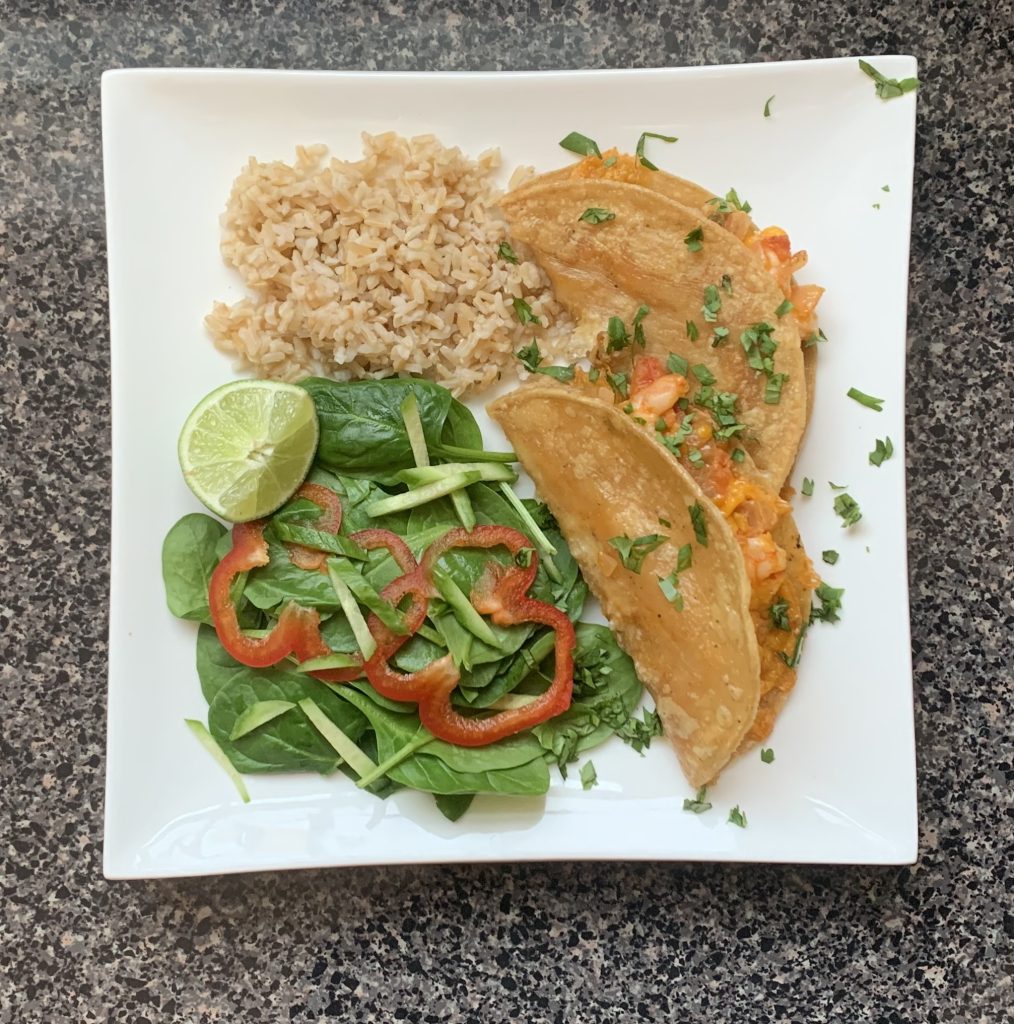
You don’t have to break out scales and measuring spoons to create this balance. Use tools like the USDA’s MyPlate Method. It’s a good quick visual guide to help you decided what to add to your plate. And when in doubt, you can always add more non-starchy veggies.
Now, not every meal you eat will be perfectly balanced.
And that’s ok. I also love fries with my burger (not streamed broccoli). You won’t undo all your progress if you’re missing veggies occasionally…As long as you’re eating balanced meals most of the time.
And I know that feels “bad”. Like “oh that was bad, I shouldn’t have eaten that”. But think of it this way…
If someone is mostly eating fried foods, sweets, sodas and they eat a serving of broccoli…it’s not going to make much of a difference.
Which means that occasional meal you have with your greens is also not going to derail you as long as you OVERALL have a balanced eating pattern. Think big picture.
Just start with your favorites and see how you can make them more balanced.
3. Upgrade your favorites.
A great place to start is with foods you already love. Because you know. You like them already.
So take that pasta and ask yourself what you can add to make it more balanced. Probably some veggies and a protein.
Or get that burger but try a side of veggies with a smaller portion of fries.
Getting started is the easy part. But making lasting habits is where most people struggle.
Section 4: How to Build Habits That Stick
Lasting change isn’t about willpower. A lot of times, our healthy habits fail because they weren’t easy to keep choosing.
So we need to make it easy for us to keep choosing our healthy habit.
Now yes there is some degree of “just do it”. Like brushing your teeth. I don’t know anyone who is passionate about brushing their teeth. Most of us do it out of habit. Which is fine. Because even when we’re exhausted in the morning or before bed, we still do it.
We want our food habits to be the same. Easy to just do.
How do we build lasting habits for healthy eating?
Start small
You will get overwhelmed if you try to overhaul your entire diet. And that’s more stress than you need (which is not good for weight loss).
So start with 1 thing. Maybe it’s adding more veggies to your dinner plate. Or it’s eating breakfast so you’re not absolutely ravenous by lunch.
Doesn’t matter what you start with. It matters that you start. And then keep doing whatever you picked for at least 2 weeks.
Use habit stacking
Once you’ve got momentum, try habit stacking. Basically link your habits.
Behavior scientist BJ Fogg, PhD gives us an easy habit stacking formula:
After I do [CURRENT HABIT], I will [NEW HABIT].
For example, after I cook, I’ll wash my dishes (instead of leaving them until the next morning).
We can use the same formula for building habits that support our healthy balanced eating pattern.
Let’s say right now you never have time to make breakfast, so you skip it. And then you’re starving by lunch. Using this habit stacking formula, you could say,
“After I cook dinner, I’ll prepare breakfast for tomorrow.” And get specific. Are you going to prepare overnight oats, eggs with spinach (you can heat up at work), or a protein shake with some fruit?
The more specific you are, the easier it is to make changes. SMART goals have a time and a place. And this is one of them.
Ask yourself what you’re doing right
You will have days where you overeat, order takeout or don’t eat veggies. That’s life. But it’s so easy to focus on what we did “wrong”. And if we pause and ask what we’re doing right, it helps us see things more objectively. I bet you’re doing a lot right. And we want to recognize that. Because healthy eating is about consistency, not perfection.
And consistency just means doing something more often than not.
That’s how you lose weight with healthy eating. Consistency.
Final Thoughts: Losing Weight with Healthy Eating Comes Down to This
You don’t need to follow a rigid plan or overhaul your entire life to start eating healthier and feeling better in your body.
The truth is, sustainable weight loss doesn’t come from perfection. It comes from small choices you can repeat with consistency because you have the skills you need.
In this post, you’ve learned:
- Why strict diets don’t work (and what balanced eating does differently)
- How resistance training and fueling your body work together
- Practical ways to eat healthier without giving up the foods you love
- How to build habits that last — even on your busiest, most imperfect days
The best place to start? Pick one thing. Just one.
Add more veggies to your next plate. Try breakfast this week. Build a meal you actually enjoy. That’s how momentum starts.
And if you want a simple tool to make balanced choices easier, check out my Make Any Meal Healthy Starter Kit — it’s a flexible, plug-and-play guide designed to help you feel confident about what you put on your plate.
You’ve already tried the hard way. Now let’s try something that actually fits your life.
If the kickstarter isn’t for you right now, check out my newsletter.
Nutrition isn’t about extremes—it’s about balance.
So if you’re questioning whether that snack has *high protein* or what you need to fuel your body and mind—here’s your answer to “is this healthy?”

 Savor the Flavor: 25+ Low Sodium Snacks You’ll Love
